What is a welcome sequence?
A welcome sequence is a short series of emails that goes out automatically after someone joins your list, starting with what they signed up for. It introduces you while they still remember why they subscribed, and it does the job a single welcome email cannot: teach something, then ask for something.
What it means in practice
Most email tools build this as an automation, sequence, flow or drip: a trigger and a list of emails with delays between them. Set the trigger to “confirms subscription” if you use double opt-in, so the sequence starts after the confirmation.
Read the whole series with a second address before you switch it on. People who subscribed earlier won’t get it unless you add them, which is usually fine.
How Chapbook uses it
On a paid plan, the launch campaign writes a 5-email sequence from the finished book, in your voice. The first email delivers the book, the next three each teach one lesson from a chapter, and the last points to the book’s next step.
Links open your book’s public page once it is published, tagged so its numbers show the readers who came from the emails. The exception is the last email of a book with a next step: its link goes straight to your own address, not the page, so it counts in your analytics, through its own UTM tags unless you turned them off. You paste the emails into your own tool, a few days apart.
The sample on this page is a guide to writing a longer sequence by hand. Its outline shows what each of its seven emails does.
In a real book
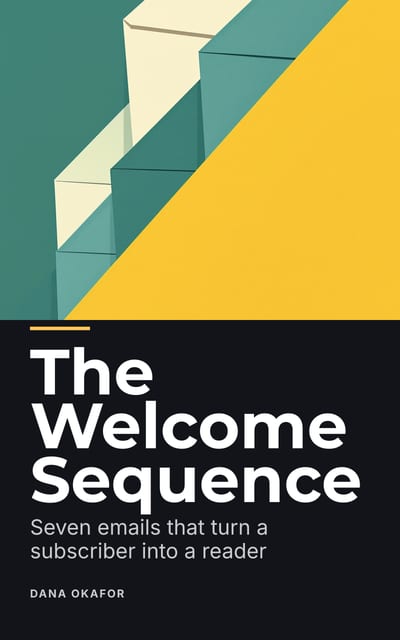
The Welcome Sequence
Seven emails that turn a subscriber into a reader, by Dana Okafor
Lead magnet, 3,626 words, 17 pages
The outline the planner proposed from its brief, chapter by chapter:
- 01 Introduction 282 words
- 02 Email 1: The one they actually open 681 words
- 03 Emails 2 and 3: Who you are and what to expect 729 words
- 04 Emails 4 and 5: Your best two pieces, reframed 669 words
- 05 Emails 6 and 7: The ask, and the door left open 743 words
- 06 The schedule and the template 478 words
Related terms
- What is a lead magnet funnel? A lead magnet funnel is the path from a free offer to a subscriber to a customer. The steps it takes, and which of them Chapbook handles and which your email tool does.
- What is double opt-in? Double opt-in means a new subscriber confirms their address from an email before joining a list. Why lists use it, and how it works with Chapbook's sign-ups.
- What is a merge field in email? A merge field is a placeholder in an email that your tool replaces with each subscriber's details, such as a first name. How to use one, and what Chapbook passes on.
Make one
Questions people ask
How many emails should a welcome sequence have?
There is no rule. Chapbook's launch campaign writes 5, and the sample on this page, a guide to writing one by hand, plans seven over sixteen days. Fewer, better emails beat a long series you can't keep useful.
Does Chapbook send the welcome sequence?
No. Chapbook writes the emails and you paste them into your own email tool's automation. Chapbook never sends email to a reader.
Read a chapter of your own book before you pay for it.
The outline, one sample chapter up to 2,500 words and a watermarked cover are free: 60 Book Credits on sign-up, no card.