The Welcome Sequence
Seven emails that turn a subscriber into a reader · Dana Okafor
- Type
- Lead magnet (1,000-10,000 words)
- As generated
- 3,626 words · 17 pages
- Trim and style
- US Letter, 8.5 × 11 in. Modern look, artwork cover.
- First draft
- Uses up to 70 credits
What this shows: one brief, run once through Chapbook at the lead magnet length and exported without a word of editing afterwards. It is not a customer's book.
The brief
- Topic
- A seven-email welcome sequence for a new newsletter: what each email does, what to write, and when to send it
- Promise
- By the end you have a complete seven-email welcome sequence drafted, with a send schedule
- Reader
- Someone with fewer than a thousand subscribers who writes the newsletter themselves
- Outcome
- A drafted sequence loaded into their email tool this week
- Voice
- Second person, warm and direct, worked examples with fictional newsletters, no invented open-rate statistics
- Call to action
- Reply to the email that delivered this guide with the word SEQUENCE for the fill-in template
- Positioning
- For new newsletter writers: the first seven emails, written for you to adapt.
The guided brief in the app asks for exactly these fields.
What the planner proposed
Title options: The Welcome Sequence, Seven Emails Before the First Issue, Hello, Then What?, From Sign-Up to Reader, The First Seven. Positioning: For solo writers and small teams with a sign-up form, fewer than a thousand subscribers, and nothing between the confirmation and the next issue. It hands them seven short emails, each explained, exemplified with fictional newsletters, and scheduled, so that a drafted welcome sequence is loaded into their email tool by the end of the week.
- 01Introductionfront, 282 words
- 02Email 1: The one they actually openbody, 681 words
- 03Emails 2 and 3: Who you are and what to expectbody, 729 words
- 04Emails 4 and 5: Your best two pieces, reframedbody, 669 words
- 05Emails 6 and 7: The ask, and the door left openbody, 743 words
- 06The schedule and the templateback, 478 words
Read the chapter synopses the planner wrote
- IntroductionPromise: the reader recognises the silent gap between sign-up and first issue as the place they are losing people, and knows how to use the next twenty minutes. Key points: (1) the gap is silence, not unsubscribes, and a welcome sequence closes it; (2) each section gives one email's purpose, what to write, an example, and a send day; (3) two fictional newsletters, The Slow Garden by Mara Ellison and Shop Floor by Ade Bankole, run through every example; (4) no open-rate statistics and no hype, because the reader's list is not the average. Takeaway: read in order and draft as you go; by the last page you have seven emails and a schedule.
- Email 1: The one they actually openPromise: the reader writes the one email that is certain to be read and stops wasting it on a greeting. Key points: (1) Email 1 delivers what was promised, says who is writing in one line, and names when the next email arrives, nothing more; (2) double opt-in confirmation and the tool's default welcome are plumbing, not Email 1, and the default should be switched off; (3) a reply question is the best first action because it helps deliverability and tells you who signed up; (4) subject line names the thing inside, not 'Welcome!'. Worked examples from The Slow Garden and Shop Floor. Takeaway: draft Email 1 under 150 words tonight, set the delay to zero, and turn off the default welcome.
- Emails 2 and 3: Who you are and what to expectPromise: the reader answers the two questions a new subscriber has without knowing it, who is this and what am I in for. Key points: (1) Email 2 is the story of why the letter exists, told from the moment it became necessary, plus what you are not; (2) Email 3 sets concrete terms: cadence, length, a typical issue, what you will never do, and inbox housekeeping; (3) a reader who knows the rhythm is not surprised into unsubscribing when the first regular issue lands; (4) send days two and four. Worked examples from both newsletters. Takeaway: write the 'moment it became necessary' before anything else for Email 2, and fill in the four blanks (every ___, about ___ minutes, a typical issue is ___, I will never ___) for Email 3.
- Emails 4 and 5: Your best two pieces, reframedPromise: the reader turns two existing issues into the emails that prove the newsletter is worth its inbox slot. Key points: (1) one chosen piece with a fresh two-paragraph opening beats a list of archive links, because it is a single easy yes; (2) choose by most replies and by best representation of what the letter is for, and send the concrete one first; (3) reframe rather than forward: name the problem, say what you would change now, tell them what to do with it; (4) days seven and ten, three days apart so they can try one thing between. Worked examples from both newsletters. Takeaway: pick the two pieces tonight and write each opening under 120 words; with no archive yet, write the two pieces you wish existed.
- Emails 6 and 7: The ask, and the door left openPromise: the reader makes one honest request and ends the sequence on purpose instead of letting it trail off. Key points: (1) you have earned one ask, chosen from a reply, a forward to one specific person, or a plainly described purchase, never all three; (2) say out loud that you are asking and why, and make the ask the whole email; (3) Email 7 marks the hand-off to the regular schedule, offers one way to tune the letter, and gives an unguilted exit, which makes the people who stay feel chosen; (4) days thirteen and sixteen. Worked examples from both newsletters. Takeaway: write the ask as a single paragraph, then fill in Email 7 with the regular day, one way to tune, and the exit line in your own words.
- The schedule and the templatePromise: the seven drafts become a running automation this week. Key points: (1) a table of all seven sends with day, purpose, and subject line pattern; (2) five steps to load it into any email tool's automation feature, including testing it on yourself and switching off the default welcome; (3) keep regular issues flowing during the sequence and revisit once a season or when Emails 4 and 5 stop being your best work. Takeaway and call to action: reply to the email that delivered this guide with the word SEQUENCE to receive the fill-in template.
Research plan, 8 items to verify: Check that the fictional newsletter names (The Slow Garden, Shop Floor) and writer names (Mara Ellison, Ade Bankole) do not collide with real newsletters or public figures in the same space; rename any that do; Confirm the sequence mechanics described (trigger on subscribe or confirm, per-email delays in days or hours, a default welcome message that can be disabled, subscribing a test address) are available in the common email tools the intended reader uses, without naming vendors in the text; Verify the double opt-in explanation: the confirmation message is sent by the tool before the subscriber is on the list, so Email 1 must be the first automation step after confirmation; and more.
The book, as exported
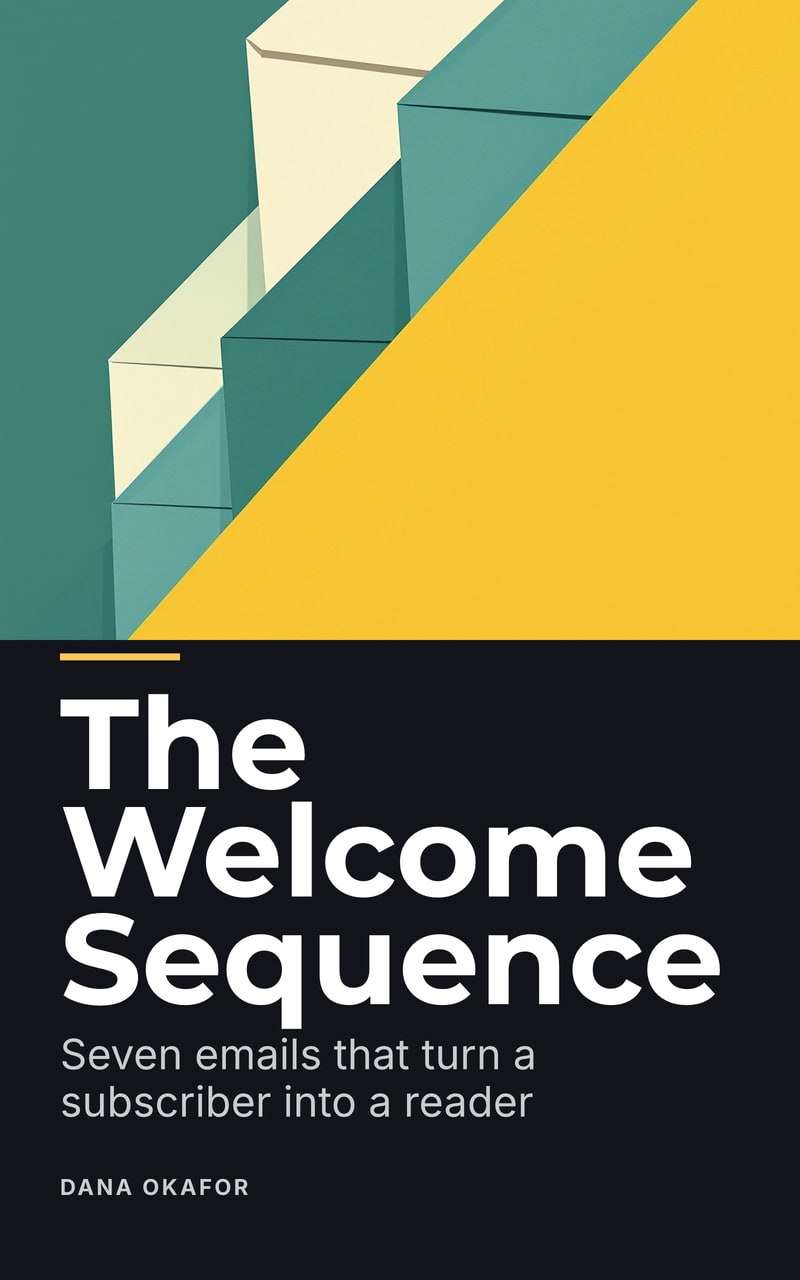


- 17 pages
- Digital PDF, 185 KB, US Letter, 8.5 × 11 in. Fonts embedded, clickable contents, running heads.
- 3,626 words
- EPUB 3, 78 KB, with a navigable table of contents. Validated against EPUBCheck.
- Cover JPEG at 1600 × 2560, the size Amazon KDP asks for. Modern look, artwork cover.
The credit figure above is what this first draft cost at the length it came out: planning, drafting every chapter, one complete review and one cover. Revisions and research add to it. See pricing for the per-action table and a calculator. Ready to write your own brief? Start free.
Write your own brief.
The outline and one sample chapter are free, so the fastest way to see whether Chapbook fits your book is to start one.