How to write in your own voice with AI
Show the AI samples of your own writing, give it specific rules, and feed it the stories and opinions only you have. Then correct one chapter before it writes the next, and edit everything yourself. Examples steer it more reliably than adjectives like “warm”. The test is simple: read a page aloud, and rewrite whatever you wouldn’t say.
Why the default voice sounds like nobody
Ask a model for a chapter with no other help, and you get its average: tidy, confident, a little too balanced. It isn’t bad writing so much as nobody’s writing.
Research points the same way. In a controlled experiment with 118 participants from India and the United States, published at CHI 2025, Agarwal, Naaman and Vashistha found that “AI suggestions led Indian participants to adopt Western writing styles, altering not just what is written but also how it is written.” The study was about writing suggestions and cultural style, not books, but the mechanism is the one to watch. If you accept the suggestion each time, your writing drifts toward the model’s.
Show it, then tell it
Anthropic’s prompting guide calls examples “one of the most reliable ways to steer Claude’s output format, tone, and structure”. That is one vendor’s advice about its own model, but the habit costs nothing to try with any of them: lead with samples, and use rules to catch what samples miss.
| Weak instruction | Stronger instruction |
|---|---|
| “Warm and professional” | “Talks like a friend who has done this before. Says ‘I got this wrong’ at least once a chapter.” |
| “Engaging” | “Open each chapter with something that happened to a real client, never with a definition.” |
| “Concise” | “Most sentences under 15 words. No paragraph over four lines.” |
| “Avoid clichés” | “Never: journey, unlock, game-changer, in today’s fast-paced world.” |
A rule you can check is one you can hold the draft to. Rules of your own also tend to be more useful than a borrowed list, because they describe what you actually do.
Your material is the voice
Most of what reads as “voice” is really content: the story you tell, the opinion you hold against the usual advice, the client who proved you wrong. A model has none of that unless you hand it over. Before drafting, write down the ten things you always end up saying about this topic and the three things people in your field get wrong. Those notes do more than any style setting.
What voice matching doesn’t change
A book that sounds like you is still a book an AI drafted, if that is how it was made. On KDP, the question of AI-generated content depends on who created the text, not on how it reads. KDP’s definition says: “We define AI-generated content as text, images, or translations created by an AI-based tool. If you used an AI-based tool to create the actual content (whether text, images, or translations), it is considered “AI-generated,” even if you applied substantial edits afterwards.” Answer on those terms, and use the AI-generated or AI-assisted helper if you aren’t sure which applies.
Where Chapbook fits
On your Author profile, add two or three pieces you wrote yourself, up to 5 samples of 20,000 characters each, and Chapbook reads them into a voice profile that drafting uses. The brief has its own voice field for each book, and your notes and sources hold your material.
You see chapter one before the rest is written, so you can correct it first. After that, assistant edits arrive as suggestions to accept or reject, and each chapter’s history records who wrote what, which feeds the record the KDP listing shows you.
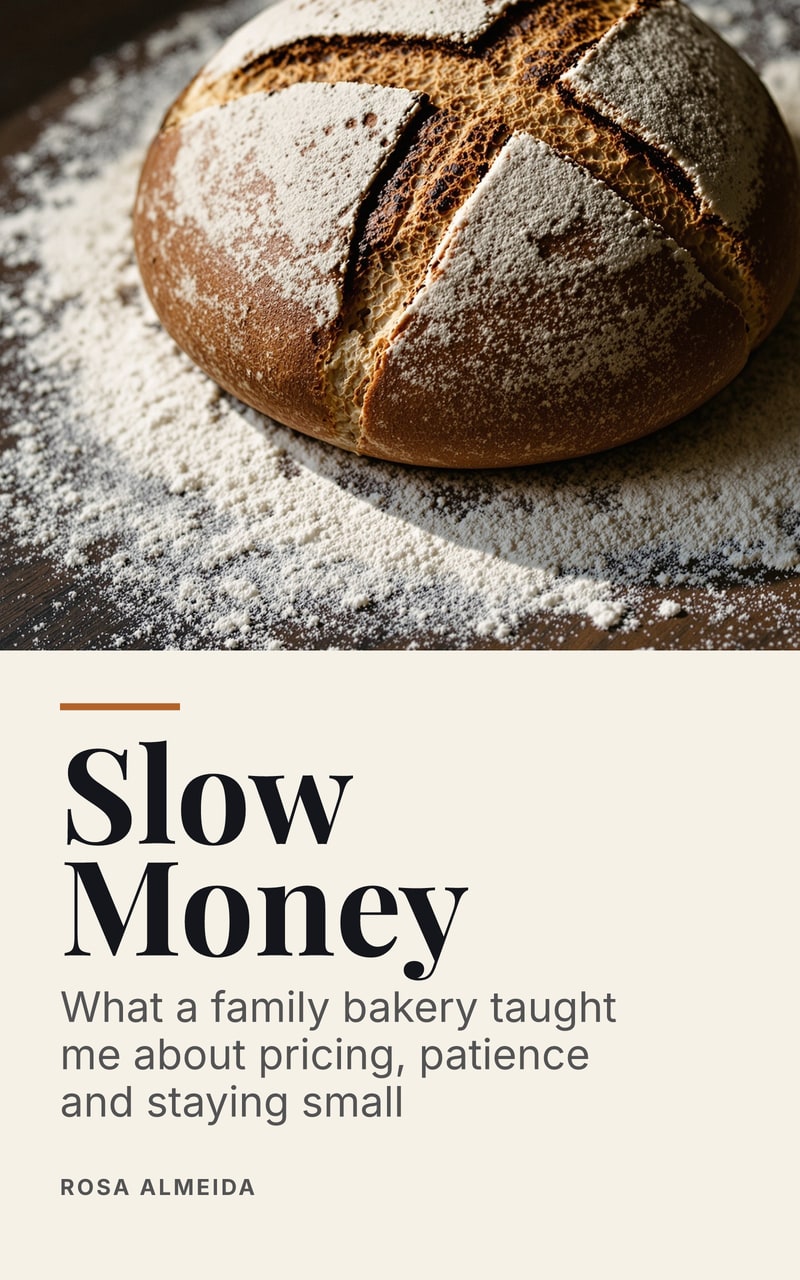
The sample on this page is a first-person book whose brief asked for narrative chapters that each end with what the author would tell a friend. Its family and its bakery are fictional, as the brief says.
What to do
-
Gather three to five real samples
Pick pieces you wrote without AI, in the register the book needs: a newsletter, a talk, a long email to a client. Five blog posts in one style beat five kinds of writing.
-
Write rules you could check
“Friendly” can’t be checked. “Short sentences, says ‘I’ and never ‘we’, no rhetorical questions, one joke a page at most” can. Add the words you would never use.
-
Give it what only you know
List the stories, client questions, mistakes and opinions the book should carry, and put them in the brief or your notes. A model can’t invent your experience, and shouldn’t try.
-
Fix one chapter before the rest
Draft one chapter and mark what sounds wrong. Tell it why, then draft again. Corrections are far cheaper now than after every chapter has the same habit.
-
Edit with your own hands
Go through every chapter. Replace generic examples with real ones, cut what you wouldn’t say, and read each page aloud. Anything you stumble over goes.