Slow Money
What a family bakery taught me about pricing, patience and staying small · Rosa Almeida
- Type
- Nonfiction book (5,000-40,000 words)
- As generated
- 9,273 words · 37 pages
- Trim and style
- 6 × 9 in. Classic look, artwork cover.
- First draft
- Uses up to 115 credits
What this shows: one brief, run once through Chapbook at the nonfiction book length and exported without a word of editing afterwards. It is not a customer's book.
The brief
- Topic
- Twenty years of running a two-shop family bakery: the decisions about price, growth and hours that kept it small and solvent
- Promise
- A clear-eyed account of how a small business stays small on purpose, with the numbers and rules of thumb that made it work
- Reader
- A small-business owner weighing a second location, a price rise, or a loan
- Outcome
- A way to decide their own next step with their own numbers, not someone else's playbook
- Voice
- First person, narrative chapters that each end with what the author would tell a friend; a fictional family, bakery and town; no invented statistics beyond the bakery's own illustrative numbers
- Positioning
- The anti-scale book: how a bakery stayed small, solvent and loved for twenty years.
The guided brief in the app asks for exactly these fields.
What the planner proposed
Title options: Slow Money, Small on Purpose, Two Shops, Not Three, The Price of a Loaf, Enough Is a Number, What the January Numbers Said. Positioning: Slow Money is for the owner of a small food or craft business who keeps being told to scale and suspects the advice is for someone else. It tells twenty years of one family bakery's decisions about price, debt, hours and growth with the numbers behind each one, so that the reader can put their own figures beside them and decide their own next step.
- 01Prologue: The Second Ovenfront, 585 words
- 02The First Price Risebody, 1,250 words
- 03The Loan We Did Not Takebody, 1,101 words
- 04The Second Shop, and Why Not a Thirdbody, 1,186 words
- 05Hours, and the Cost of Being Openbody, 1,085 words
- 06The Wholesale Account We Let Gobody, 1,142 words
- 07Hiring Family and Paying Them Properlybody, 1,216 words
- 08What the Numbers Said Each Januarybody, 1,179 words
- 09Epilogue: Small on Purposeback, 478 words
Read the chapter synopses the planner wrote
- Prologue: The Second OvenPromise: the reader meets Rosa, the bakery and the question of the book in a single scene. Key points: a reconditioned second oven arriving through the front door of the Fennick shop in the fifth year, paid for from the account; the adviser's plan the previous autumn that the oven quietly replaced; why the book is a series of decisions made with the previous year's figures rather than a philosophy; a warning not to lift the bakery's numbers but to put your own beside them. Takeaway: read each chapter as one decision with its sum, and keep your own last year's figures to hand while you do.
- The First Price RisePromise: the reader can cost their biggest seller and set a price rise they can defend. Key points: the white tin loaf held at £1.10 for six years and the discovery, after a first year that made £4,000, that each loaf earned six pence; the per-loaf cost table with every line in it; choosing £1.35 by asking how many customers could be lost before takings fell (167 of 900 loaves a week); what actually happened in the first fortnight, by the summer and by the following January, counted; the rule that a small rise every September beats a big one every six years. Takeaway: cost the thing you sell most of line by line, work out the break-even customer loss before announcing anything, and raise a little every year.
- The Loan We Did Not TakePromise: a way to test a loan against an ordinary year and a bad one before signing. Key points: the adviser's plan to buy the freehold next door for a café and bakehouse on £180,000 over fifteen years; putting the £18,600 a year of repayments beside £24,000 of profit after everyone's wages; the bad-year column, takings down a tenth with costs unchanged, that turns £5,400 spare into £12,600 short; the smallest thing that fixed the real bottleneck, an £8,400 second oven bought from cash, and the pastries it sold. Takeaway: write the repayment next to the profit after everyone is paid, add a bad-year column, and buy the smallest thing that fixes the actual problem before the big thing.
- The Second Shop, and Why Not a ThirdPromise: the reader can tell whether a new location is a distribution decision or a manufacturing one. Key points: spare oven capacity and a sister who wanted to run a shop as the two reasons Ambleford made sense; the £49,900 it cost, how it was funded without a loan, and its first three years including a losing one; the Kingsmere offer three years later and the oven-capacity table showing a third shop meant a bakehouse, which meant borrowing; the plain fact that there was only one Ines. Takeaway: a second shop sells what you already make, a third makes you a manufacturer; count the ovens and the people before you count the pounds.
- Hours, and the Cost of Being OpenPromise: an hour-by-hour method for deciding opening hours from the reader's own takings. Key points: inherited hours and ten years of being tired; four weeks of takings written down by the hour at Fennick, and what the last two and a half hours really took and really cost; closing at three, what it lost at first and what it gave back; closing on Mondays as a decision to give up about £4,000 a year for a two-day weekend, put to the staff first. Takeaway: record takings by the hour for a month, cost every hour honestly including the top-up bake, decide rather than inherit, and tell customers why.
- The Wholesale Account We Let GoPromise: a way to judge a big account by what it takes from the customers you already have. Key points: Paul Larkin's order and the page that correctly showed £18,600 a year for a third more flour and two more days of ovens; what the page did not say, the thin shelf at eight, the earlier start for Kev, thirty days becoming sixty and £22,000 owed; the price-cut letter that took the margin to £6,400; giving notice, and the table of year thirteen against year fifteen showing takings down £122,000 and profit up £14,000. Takeaway: do a second page for what the account takes from your existing trade, set a ceiling of a fifth of takings for any one customer, and treat slipping payment terms as the account already ending.
- Hiring Family and Paying Them ProperlyPromise: the reader sees their real profit once every family member is paid a proper wage. Key points: a mother who worked thirteen years unpaid and a first-year profit of £31,000 that was really £4,000; putting herself on the payroll at the rate a stranger would get, and later her mother; paying Ines and Marta exactly what the job would pay anyone, and why that ended arguments before they started; the kitchen-table conversation with Daniel and his return to joinery when the bakery could pay one owner properly but not two; what changed once everyone was paid. Takeaway: put every family member in the wages line at the market rate, starting with yourself, and use the smaller profit that results for every other decision.
- What the Numbers Said Each JanuaryPromise: a once-a-year review of eight numbers, and the rules of thumb that twenty of them produced. Key points: the exercise book and the eight numbers; the twenty-year table at years one, five, ten, thirteen, fifteen and twenty, and what its cash column shows about the one fast year; the rules in pence per pound taken (ingredients under 30, wages under 42 with the family in, the building under 12, at least 10 left), plus three months' cash before any big purchase, no customer above a fifth, one rise a year, and no borrowing for anything not already sold in a smaller form; the bad January of the Larkin's year and the cost of not believing the book on the day. Takeaway: choose your own eight numbers, turn every cost into pence in the pound, set your lines from your own good years, and write a bad January down as bad on the day you read it.
- Epilogue: Small on PurposePromise: the reader leaves with the argument of the book in plain words and permission to decide for themselves. Key points: Marta taking the keys after a slow handover; what the bakery did grow into, with the closing numbers; that the advice to scale is not neutral and that the alternative to scaling is not failure; where the family and the bakehouse are now. Takeaway: do your own page with your own numbers and let the sum decide.
Research plan, 8 items to verify: Confirm the invented names (Fennick, Ambleford, Kingsmere, Larkin's cafés, the Almeida family bakery) do not coincide with well-known real bakeries, café chains or towns in a way that would read as a claim about them; Check the bakery's arithmetic within and across chapters: the per-loaf costing and break-even volumes, the loan repayment and bad-year column, the Ambleford fit-out and three-year results, the hourly takings and Monday closure sums, the wholesale margin before and after the price cut, the first-year wages restatement, and the twenty-year January table, so that every figure cited twice agrees with itself; Verify the timeline: takeover in year one, the price rise in year two, the second oven in year five, Ambleford in year eight, hours changed in year eleven, Larkin's from year twelve to fourteen, Daniel back to joinery in year twelve, Marta joining in year sixteen, handover after year twenty; and that the ages of Rosa, Marta, Kev and Teresa stay consistent with it; and more.
The book, as exported
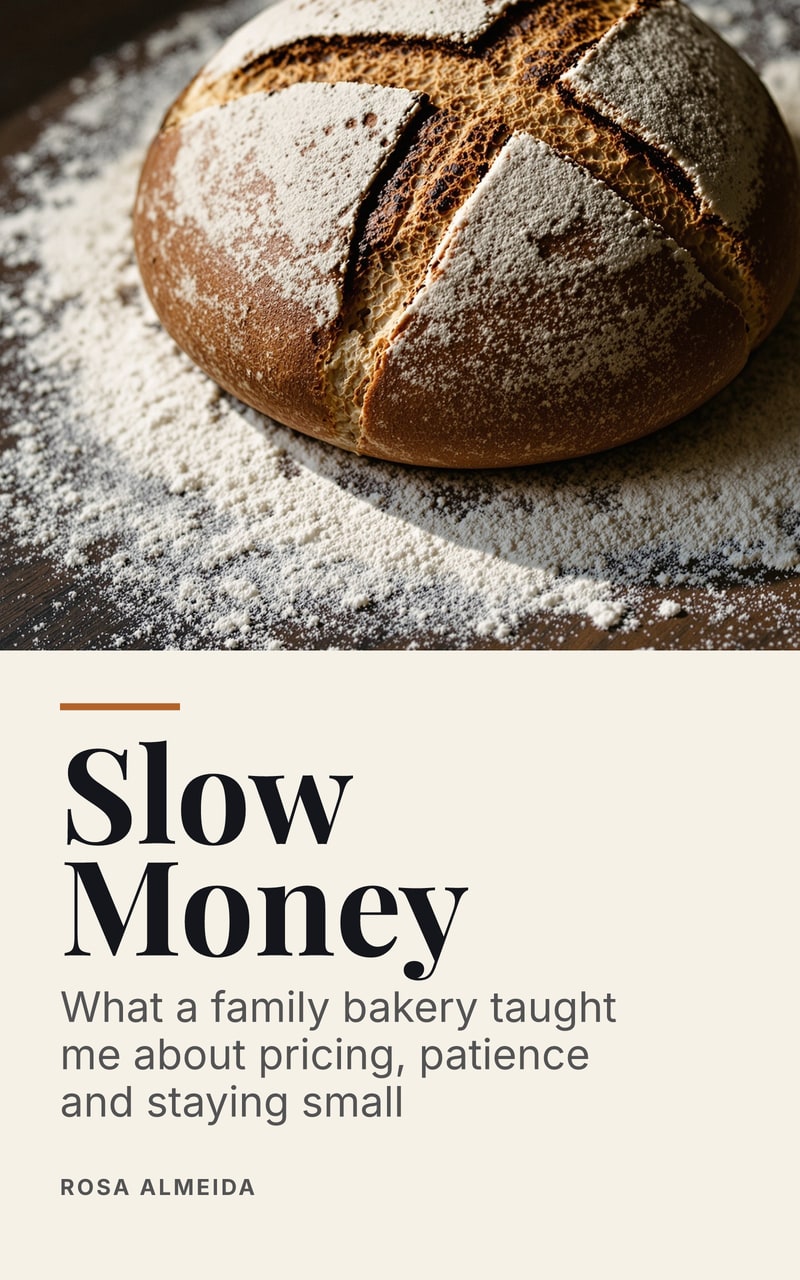


- 37 pages
- Digital PDF, 425 KB, 6 × 9 in. Fonts embedded, clickable contents, running heads.
- 9,273 words
- EPUB 3, 226 KB, with a navigable table of contents. Validated against EPUBCheck.
- Cover JPEG at 1600 × 2560, the size Amazon KDP asks for. Classic look, artwork cover.
The credit figure above is what this first draft cost at the length it came out: planning, drafting every chapter, one complete review and one cover. Revisions and research add to it. See pricing for the per-action table and a calculator. Ready to write your own brief? Start free.
Write your own brief.
The outline and one sample chapter are free, so the fastest way to see whether Chapbook fits your book is to start one.