Lead magnet ideas for coaches
The best lead magnet for a coach lets someone do a small piece of the coaching before they ever book a call: a self-assessment, a thirty-day workbook, the questions you ask in a first session. Here are ten for life, career, executive and health coaches, each a brief that opens in Chapbook, and one expanded into the outline it produced.
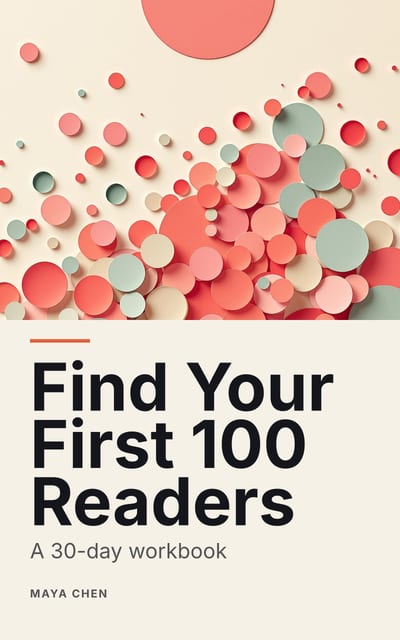
Find Your First 100 Readers
A 30-day workbook, by Maya Chen
Workbook, 5,850 words, 24 pages
The outline the planner proposed from its brief, chapter by chapter:
- 01 How to Use This Workbook 466 words
- 02 Week 1: Your Reader 1,142 words
- 03 Week 2: Your Promise and Your Page 1,168 words
- 04 Week 3: Where Your Readers Already Gather 1,294 words
- 05 Week 4: Ask, Deliver, Repeat 1,200 words
- 06 Day 30: The Review and the Routine 545 words
10 ideas, each a brief to start from
-
A 30-day workbook for one stuck outcome
A month of small daily steps shows what working with you feels like, one exercise at a time. Find Your First 100 Readers, expanded on this page, is this idea written for first-time authors, the clients a book coach works with.
Workbook Expanded above: the outline it produced. Start from this brief: A 30-day workbook for one stuck outcome
-
The self-assessment you run in a first session
Every coach has a set of questions that shows where a client really is. Put them on paper with a way to read the answers, and a stranger gets the insight of your first session and a reason to book a second.
Lead magnet Start from this brief: The self-assessment you run in a first session
-
The questions to ask before hiring a coach
People shopping for a coach don’t know what separates one from another. A fair list of questions, including ones you might not win on, earns trust before the sales call.
Lead magnet Start from this brief: The questions to ask before hiring a coach
-
A map of the conversation your client keeps avoiding
Clients often arrive stuck on one talk they can’t face. Scripts for that talk are something they will use this week, and using them shows how you think.
Lead magnet Start from this brief: A map of the conversation your client keeps avoiding
-
The week-by-week reset for a client in transition
Transitions have a shape coaches recognize and clients don’t. A short workbook for the first weeks after the change gives them footing when they are most likely to look for help.
Workbook Start from this brief: The week-by-week reset for a client in transition
-
The daily check-in sheet you hand clients anyway
If you already give clients a tracker between sessions, it is a ready-made lead magnet. People who use it for two weeks have a record of their own patterns to bring to a first call.
Workbook Start from this brief: The daily check-in sheet you hand clients anyway
-
The framework you draw on every whiteboard
If you sketch the same model in every session, it deserves its own illustrated guide. Prospects start using your language, and clients get something to refer back to.
Illustrated guide Start from this brief: The framework you draw on every whiteboard
-
Your signature method, as a real book
A full book is what you hand a corporate buyer or a podcast host. It sets out your method in enough depth that the conversation starts with how to apply it, and it stays useful after the first read.
Nonfiction book Start from this brief: Your signature method, as a real book
-
Client stories, told as turning points
Before-and-after claims are easy to doubt. A short collection about what shifted, written with each client’s permission and without income figures, shows the work itself.
Collection Start from this brief: Client stories, told as turning points
-
A one-page brochure for your group program
When a past client wants to recommend you, a short brochure gives them something to forward. It says who the program is for, what happens each week and how to ask about it.
Brochure Start from this brief: A one-page brochure for your group program
How to choose one
Listen for what people say in the first ten minutes of a discovery call. If they can’t tell what is wrong, write the self-assessment. If they know what is wrong and can’t start, write the workbook. If they are comparing you with other coaches, write the guide to choosing one and be fair in it.
Keep your promise to something the reader can check for themselves, such as “a scored answer to whether to stay or go.” Leave out income figures and promised results: you can’t know them for a reader you have never met, and the people you want to work with tend to distrust them.
Every brief here opens in Chapbook
Each idea comes with the paragraph Chapbook needs to start: the topic, the reader and the voice. Open one, change the client and the situation to yours, and add your session notes or talks as sources so the chapters draw on what you actually teach. Chapbook proposes titles and an outline to approve before anything is drafted. The first idea is shown expanded: the outline the planner proposed for it, and the book it became.
Questions people ask
What makes a good lead magnet for a coach?
One that lets a reader do a small part of the work with you and see a result they can check, such as a score, a decision or a finished exercise. It should come from what you already do in sessions.
Should a coach give away their method for free?
A lead magnet can show how you think without replacing coaching. Readers can follow the steps on paper, but they still can’t get your questions about their own situation or someone holding them to it.
Can readers type into a coach’s workbook on screen?
Yes, if you turn on Fillable answers in the look. Readers can then type on the answer lines and tick the boxes in the digital PDF. The paperback interior, EPUB and Word file don’t have fields.
Read a chapter of your own book before you pay for it.
The outline, one sample chapter up to 2,500 words and a watermarked cover are free: 60 Book Credits on sign-up, no card.