Find Your First 100 Readers
A 30-day workbook · Maya Chen
- Type
- Workbook (1,000-20,000 words)
- As generated
- 5,850 words · 24 pages
- Trim and style
- US Letter, 8.5 × 11 in. Editorial look, artwork cover.
- First draft
- Uses up to 87 credits
What this shows: one brief, run once through Chapbook at the workbook length and exported without a word of editing afterwards. It is not a customer's book.
The brief
- Topic
- A 30-day plan to find the first hundred readers for a nonfiction book without paid advertising
- Promise
- By day 30 you will have a named reader, a one-sentence promise, a short list of places that reader already gathers, and either your first hundred readers or a routine that keeps adding them
- Reader
- Someone who wrote the book on evenings and weekends, dislikes self-promotion, and has fewer than two hundred followers anywhere
- Outcome
- A 30-to-60-minute daily routine they can keep after the workbook ends
- Voice
- Second person, a coach at the kitchen table; a short lesson, then a fill-in exercise; checklists at the end of each week; no invented statistics
- Positioning
- For authors who would rather write than promote: thirty days of small, specific asks that add up to a first hundred readers.
The guided brief in the app asks for exactly these fields.
What the planner proposed
Title options: Find Your First 100 Readers, The First Hundred, Readers Before Ads, One Reader at a Time, Thirty Days of Small Asks. Positioning: For authors who would rather write than promote: thirty days of small, specific asks that add up to a first hundred readers. Each day is a short lesson, a fill-in exercise, and one message to send, so that by day 30 you have a named reader, a one-sentence promise, a page, a places list, and a routine you can keep in under an hour a day.
- 01How to Use This Workbookfront, 466 words
- 02Week 1: Your Readerbody, 1,142 words
- 03Week 2: Your Promise and Your Pagebody, 1,168 words
- 04Week 3: Where Your Readers Already Gatherbody, 1,294 words
- 05Week 4: Ask, Deliver, Repeatbody, 1,200 words
- 06Day 30: The Review and the Routineback, 545 words
Read the chapter synopses the planner wrote
- How to Use This WorkbookPromise: the reader understands what a 'reader' is, what each day asks of them, and how the four weeks fit together. Key points: (1) a reader is a countable person with the book or a chapter in hand, not a follower; (2) every day is 30 to 60 minutes split into read, write, send; (3) later exercises use earlier answers, so write in the book; (4) one ask a day is on schedule, and a missed day is picked up, not doubled. Takeaway: a shared definition of success, the daily time table, and three rules the rest of the workbook relies on.
- Week 1: Your ReaderDays 1 to 7. Promise: by day 7 the author has one named reader, described in a specific moment, in that reader's own words, and has checked the description against two real people. Key points: (1) one reader, not an audience, is what gets a book passed on (Lesson 1); (2) the reader's words, not the book's chapter titles, are how you will find and address them (Lesson 2); (3) the first readers come from ten people you already know, and the first message is a two-question check, not a pitch (Lesson 3, with the exact message). Takeaway: Exercise 1 (reader description), Exercise 2 (their words and the sentence in the book that answers them), Exercise 3 (ten names, two conversations, corrected reader). Ends with Exercise 3 and the Week 1 checklist.
- Week 2: Your Promise and Your PageDays 8 to 14. Promise: by day 14 the author can say what the book does in one breath and has a single page to send anyone. Key points: (1) a promise has four parts (reader, situation, what the book does, what changes) and a spoken version with no hype words (Lesson 4); (2) the page says five things in order and nothing else (Lesson 5); (3) a three-line bio establishes common ground with the reader, not credentials (Lesson 6); the reader tally opens this week. Takeaway: Exercise 4 (three drafts, a spoken version, tested on two people), Exercise 5 (the page written out), Exercise 6 (the bio). Ends with Exercise 6 and the Week 2 checklist.
- Week 3: Where Your Readers Already GatherDays 15 to 22. Promise: by day 22 the author has eight places where the reader already asks, listens, meets, or trusts, has been useful in two of them without mentioning the book, and has sent one offer to a host. Key points: (1) places come in four kinds and are found with the reader's words, not the title (Lesson 7); (2) be useful three times before you ask, with no link and no signature (Lesson 8); (3) hosts, admins, and newsletter writers have a recurring need you can meet, and the offer is work, not the book (Lesson 9, with the exact podcast-host and group-admin messages). Takeaway: Exercise 7 (places list), Exercise 8 (three useful answers logged), Exercise 9 (five hosts, one message sent, date noted). Ends with Exercise 9 and the Week 3 checklist.
- Week 4: Ask, Deliver, RepeatDays 23 to 29. Promise: by day 29 the author has made an ask every day, delivered on every yes, followed up once, and kept a log that shows which place and which ask work. Key points: (1) four small asks in order (the read, the copy, the pass-on, the word) with copyable scripts for a friend, a place, and one of the ten (Lesson 10); (2) deliver within a day, follow up once with a content question, then let go (Lesson 11); (3) count asks sent, not replies, and write the message the night before to shrink the moment before sending (Lesson 12). Takeaway: Exercise 10 (three asks in the author's words), Exercise 11 (delivery note and follow-up question), Exercise 12 (the asks log for days 23 to 29). Ends with Exercise 12 and the Week 4 checklist.
- Day 30: The Review and the RoutinePromise: the author leaves with an honest reader count, a clear view of which place and which ask produced readers, and a written routine of 30 to 60 minutes they can keep. Key points: (1) count readers who have replied about the book, and do not round up; (2) most readers come from one or two places and one kind of ask, so the routine keeps those and drops the rest; (3) the routine has four parts: show up, ask, deliver, count. Takeaway: Exercise 13 (the review), Exercise 14 (the routine with a day, time, place, and default ask), the final checklist of every artefact produced, and the tally page.
Research plan, 8 items to verify: Confirm that the main self-publishing retailers let authors edit the book description after publication, so 'your page' can be the retailer page in Lesson 5; if not, keep the one-page site or pinned post as the primary suggestion; Check whether ebook exclusivity programs restrict sending a free chapter or a full free copy outside the retailer, and add a one-line note telling the author to check their own distribution terms before the 'copy' ask; Verify current podcast guest-pitch etiquette (pitch length, offering a specific segment, not attaching the book) so the Lesson 9 host script reflects what hosts actually respond to; and more.
The book, as exported
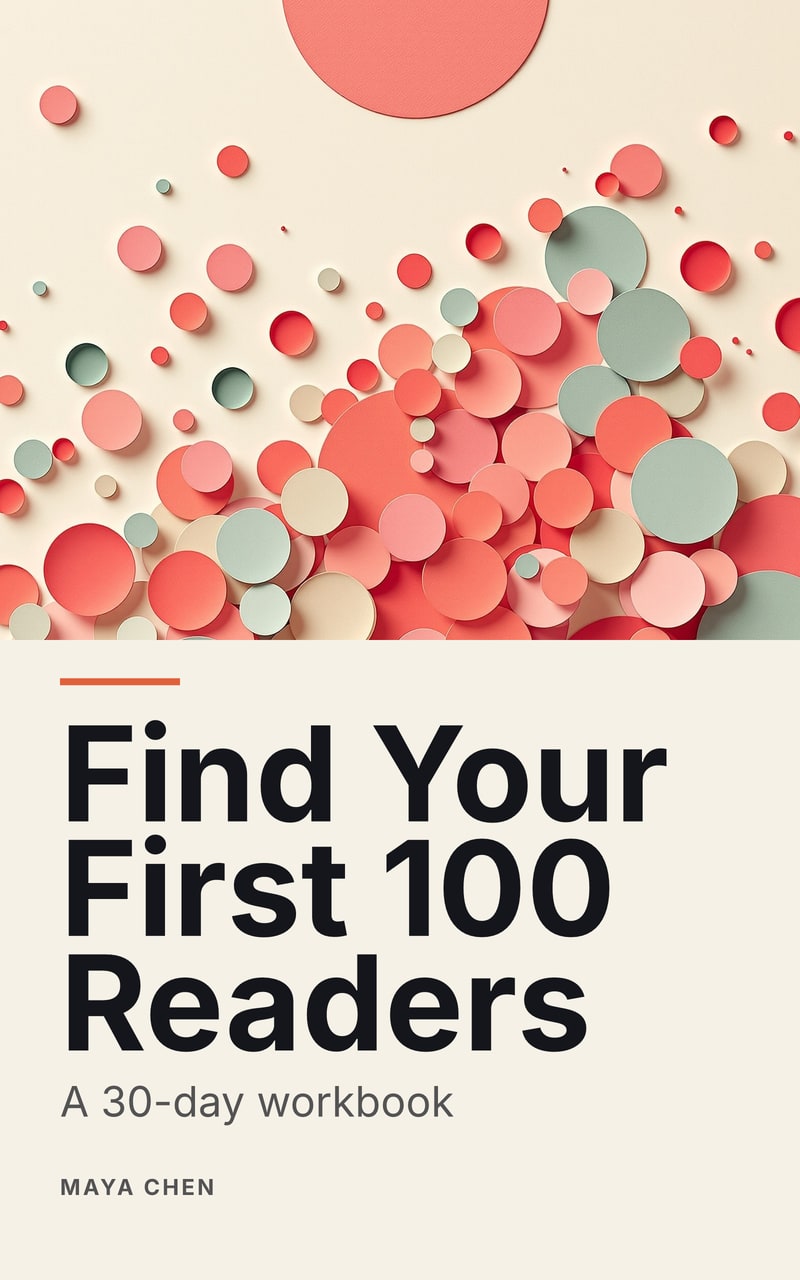


- 24 pages
- Digital PDF, 282 KB, US Letter, 8.5 × 11 in. Fonts embedded, clickable contents, running heads.
- 5,850 words
- EPUB 3, 125 KB, with a navigable table of contents. Validated against EPUBCheck.
- Cover JPEG at 1600 × 2560, the size Amazon KDP asks for. Editorial look, artwork cover.
The credit figure above is what this first draft cost at the length it came out: planning, drafting every chapter, one complete review and one cover. Revisions and research add to it. See pricing for the per-action table and a calculator. Ready to write your own brief? Start free.
Write your own brief.
The outline and one sample chapter are free, so the fastest way to see whether Chapbook fits your book is to start one.