Skip to content

KDP’s two-titles-per-week limit: what changed and what to do

Since Monday 21 September 2026, Amazon KDP allows two new titles per format per week, down from ten, and since 5 October it also limits first submissions to two per format per week. The count resets every Sunday at 00:00 UTC, and the limit applies only to new titles: books you have already published are not affected.

What the limit counts

From Monday 21 September 2026, Amazon KDP allows two new titles per format per week, where the limit had been ten. Amazon announced it on the KDP Community; the earlier figure of ten comes from ALLi, the Alliance of Independent Authors, which reported the change on 24 September.

Four details decide how it affects you:

  • It is per format. Ebook, paperback and hardcover each have their own two slots, so two books can each go out in all three formats in the same week.
  • It covers new titles only. Books already on sale are not affected.
  • Submitting has a limit too. Amazon added on 5 October 2026 that you can submit up to two new titles per format each week for publication. That counts the first time you submit a title, including titles saved as drafts. Updates to titles you have already submitted do not count.
  • It resets on Sunday. The week starts again every Sunday at 00:00 UTC, when it is still Saturday in the Americas.

Why Amazon changed it

Amazon’s announcement gives one reason: “to help maintain a positive publishing experience for all authors.” ALLi’s report connects the cap to the growth in AI-generated titles; Amazon’s announcement does not say so.

What it means if you publish often

If you publish a few books a year, two new titles a week changes nothing. It matters if you release a series in one go or publish short books in quick succession. In each case the answer is a calendar: a dated list of what is finished, released two per format per week.

It also changes where a book does its work. A title on KDP reaches readers through Amazon. A free guide given away from your own page reaches them through your list, and Amazon’s weekly count does not apply to it. When the next title is allowed out, the list is who you tell.

Where Chapbook fits

Chapbook does not publish to KDP. It makes the files you upload: a typeset digital PDF, an EPUB 3, a Word document and a cover JPEG at the size KDP asks for. It also lays out the listing in the order of KDP’s own form, AI-content answers included, for you to copy across. Separately, on a paid plan, a book can have its own Chapbook page that collects readers’ emails, which no KDP limit counts.

What to do

  1. Count each format on its own

    The limit is two new titles per format, so the same two books can go out as ebooks, paperbacks and hardcovers in one week. Plan each format’s two slots separately.

  2. Plan releases a week at a time

    The week resets every Sunday at 00:00 UTC. Keep a dated list of what is ready, and queue no more than two new titles per format before each reset.

  3. Spend the slots on finished books

    With two slots a week, publish the books you have read, edited and checked. A rushed upload uses a slot that a finished book could have had.

  4. Build a list the limit does not touch

    The limit applies to what you publish on KDP, not to what you give away. A free guide on your own page collects readers you can tell about every new title, whenever it is allowed out.

  5. Re-read the rule before each launch

    Amazon announced the change in a short KDP Community post and can change it again. Check the announcement before you plan a launch around it.
Made with Chapbook

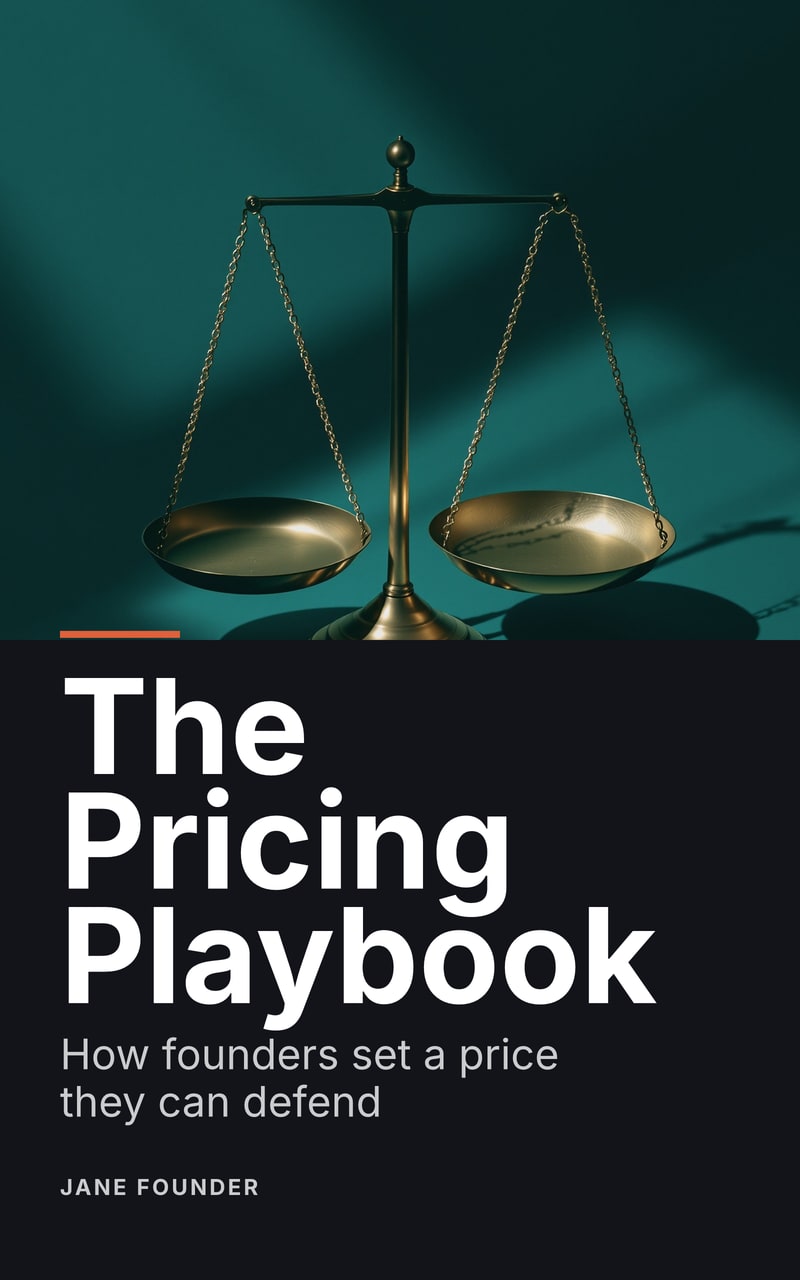
Cover of The Pricing Playbook by Jane Founder: a brass balance scale lit from the left on deep teal above white type, subtitle “How founders set a price they can defend”.
Title page. Page 1 of The Pricing Playbook.
Copyright. Page 2 of The Pricing Playbook.
Contents. Page 3 of The Pricing Playbook.
Introduction. Page 4 of The Pricing Playbook.
Introduction. Page 5 of The Pricing Playbook.
Why Guessing Fails. Page 6 of The Pricing Playbook.
Why Guessing Fails. Page 7 of The Pricing Playbook.
Why Guessing Fails. Page 8 of The Pricing Playbook.
Why Guessing Fails. Page 9 of The Pricing Playbook.
What You Are Actually Selling. Page 10 of The Pricing Playbook.
What You Are Actually Selling. Page 11 of The Pricing Playbook.
What You Are Actually Selling. Page 12 of The Pricing Playbook.
What You Are Actually Selling. Page 13 of The Pricing Playbook.
Interview Ten Customers. Page 14 of The Pricing Playbook.
Interview Ten Customers. Page 15 of The Pricing Playbook.
Interview Ten Customers. Page 16 of The Pricing Playbook.
Interview Ten Customers. Page 17 of The Pricing Playbook.
Interview Ten Customers. Page 18 of The Pricing Playbook.
Choose the Value Metric. Page 19 of The Pricing Playbook.
Choose the Value Metric. Page 20 of The Pricing Playbook.
Choose the Value Metric. Page 21 of The Pricing Playbook.
Choose the Value Metric. Page 22 of The Pricing Playbook.
Draft Three Tiers. Page 23 of The Pricing Playbook.
Draft Three Tiers. Page 24 of The Pricing Playbook.
Draft Three Tiers. Page 25 of The Pricing Playbook.
Draft Three Tiers. Page 26 of The Pricing Playbook.
Set the Numbers. Page 27 of The Pricing Playbook.
Set the Numbers. Page 28 of The Pricing Playbook.
Set the Numbers. Page 29 of The Pricing Playbook.
Set the Numbers. Page 30 of The Pricing Playbook.
Say the Price Out Loud. Page 31 of The Pricing Playbook.
Say the Price Out Loud. Page 32 of The Pricing Playbook.
Say the Price Out Loud. Page 33 of The Pricing Playbook.
Say the Price Out Loud. Page 34 of The Pricing Playbook.
Revisit Every Quarter. Page 35 of The Pricing Playbook.
Revisit Every Quarter. Page 36 of The Pricing Playbook.
Revisit Every Quarter. Page 37 of The Pricing Playbook.
Revisit Every Quarter. Page 38 of The Pricing Playbook.
Conclusion. Page 39 of The Pricing Playbook.
Conclusion. Page 40 of The Pricing Playbook.
Appendix: The Interview Script. Page 41 of The Pricing Playbook.
Appendix: The Interview Script. Page 42 of The Pricing Playbook.
Back cover of The Pricing Playbook: the description over the cover's artwork.
Introduction 5 / 44
The Pricing Playbook, how founders set a price they can defend: a nonfiction book of 9,862 words and 43 pages on 6 × 9 in, generated from one brief and exported unedited. It is a sample, not a customer's book. Download the PDF (381 KB) or the EPUB (107 KB).

Questions people ask

How many books can I publish on KDP per week?

Two new titles per format per week, since 21 September 2026, according to Amazon’s KDP Community post. Since 5 October it also limits first submissions to two per format per week.

When does the KDP weekly limit reset?

The KDP weekly limit resets every Sunday at 00:00 UTC (12:00 AM UTC), according to Amazon’s KDP Community post, read on 31 October 2026.

Does the limit affect books I have already published?

No. Amazon says the limit applies only to creating new titles, and that existing or published titles are not affected. Updates to titles you have already submitted do not count toward the submission limit.

Are the ebook and paperback of one book counted together?

No. The limit counts each format separately, so two titles can be released as ebook, paperback and hardcover in the same week.

What was the KDP weekly limit before September 2026?

Ten new titles per week, a cap that had come into effect the year before, according to ALLi’s report of 24 September 2026.

Does Chapbook upload books to KDP?

No. Chapbook exports the files and lays out the listing in KDP's own field order; you upload with your own KDP account.

Read a chapter of your own book before you pay for it.

The outline, one sample chapter up to 2,500 words and a watermarked cover are free: 60 Book Credits on sign-up, no card.