The Pricing Playbook
How founders set a price they can defend · Jane Founder
- Type
- Nonfiction book (5,000-40,000 words)
- As generated
- 9,862 words · 43 pages
- Trim and style
- 6 × 9 in. Editorial look, artwork cover.
- First draft
- Uses up to 119 credits
What this shows: one brief, run once through Chapbook at the nonfiction book length and exported without a word of editing afterwards. It is not a customer's book.
The brief
- Topic
- A repeatable method for pricing software: customer interviews, a value metric, tiering, and setting numbers you can defend
- Promise
- A repeatable method for setting a price you can defend to customers, investors and yourself, validated by ten customer interviews in a week
- Reader
- A founder who priced by guessing or by copying a competitor and now has to defend or change the number
- Outcome
- Run the interviews, choose a value metric, draft three tiers, set the numbers, say them out loud to customers, and revisit them every quarter
- Voice
- Direct second person with occasional first person; worked examples with fictional companies; tables where they clarify; no invented statistics or named studies: reason from mechanics and examples
- Positioning
- For founders who guessed: the week-long method that replaces the guess with a number and a reason.
The guided brief in the app asks for exactly these fields.
What the planner proposed
Title options: The Pricing Playbook, A Price You Can Defend, Ten Interviews to a Price, Stop Guessing at Pricing, The Number and the Reason. Positioning: The Pricing Playbook is for founders who priced by guessing or by copying a competitor and now have to defend or change the number. It replaces the guess with a week-long method: ten customer interviews, one value metric, three tiers, numbers with a reason attached, and a ninety-minute quarterly review that keeps them honest.
- 01Introductionfront, 620 words
- 02Why Guessing Failsbody, 1,014 words
- 03What You Are Actually Sellingbody, 1,004 words
- 04Interview Ten Customersbody, 1,088 words
- 05Choose the Value Metricbody, 979 words
- 06Draft Three Tiersbody, 1,076 words
- 07Set the Numbersbody, 1,130 words
- 08Say the Price Out Loudbody, 1,063 words
- 09Revisit Every Quarterbody, 994 words
- 10Conclusionback, 384 words
- 11Appendix: The Interview Scriptback, 475 words
Read the chapter synopses the planner wrote
- IntroductionPromise: the reader understands why their current price cannot be defended and sees the whole method before doing any of it. Key points: the guess was reasonable on launch day but has no reason attached; the method is five steps and a habit (interviews, value metric, three tiers, numbers, say it out loud, quarterly review); the book reasons from mechanics and a running fictional company, Cronbell, rather than from statistics or named studies. Opens with the fixed first paragraph and includes a short 'Who this is for' list. Takeaway: read straight through once, then do the chapter tasks in order, which chain into a defensible pricing page within two weeks.
- Why Guessing FailsPromise: the reader can name which kind of guess they made and what it is costing them. Key points: Cronbell's founder priced at nineteen dollars per seat by copying a competitor and now has her largest customer paying four times what her smallest pays for two hundred times the coverage; the four ways founders guess (copy a competitor, cost-plus, the number that feels fair, the template); the mechanical costs of a guess (a revenue ceiling, price-sensitive customers, no defence against discounts or investor questions, a frozen number); what 'defensible' actually means and a one-page table of the method. Takeaway: write your current price and the reason for it in one sentence, notice whether it contains 'competitor', 'felt' or 'seemed', and keep it to rewrite after the numbers chapter.
- What You Are Actually SellingPromise: a one-page value hypothesis to test in the interviews, so the interviews are not a survey. Key points: features are what you built, outcomes are what customers buy, shown through Cronbell's two attempts at a value statement; the four kinds of value (money made, money saved, time saved, risk reduced) with a comparison table for Cronbell and a second fictional company, Doorframe; value drivers as quantities in the customer's world and the shortlist they create for the metric; naming the real alternatives honestly, including the homegrown script and the unused enterprise suite. Takeaway: a filled hypothesis template (outcome sentence, three candidate drivers, alternatives list) written before any interview is booked.
- Interview Ten CustomersPromise: ten interviews scheduled, run and scored in a single week. Key points: why ten and why a week; a segment mix of three happy customers, three recent signups, two lost, two prospects, and how to get the meetings by asking about twenty; how to run one (stories not opinions, numbers in their words, no pitching, price last and as four ranges rather than a single number); a scoring sheet with Cronbell's ten rows and how to read it for patterns, including the discovery that customers talk in jobs, not seats. Takeaway: by Friday, a filled scoring table and three sentences underneath it: the outcome customers name, the driver they reach for, and the alternative they compare you to.
- Choose the Value MetricPromise: a value metric chosen against explicit tests and stated in one sentence. Key points: the metric is the most consequential pricing decision because it decides whose bill grows; six tests (tracks value, customer can predict it, you can measure it, grows with their success, does not punish the moment of need, fits in one sentence); a comparison table of Cronbell's candidates (seats, monitored jobs, alerts sent, projects) showing why alerts-sent punishes the worst night of the month and seats fail to track value; the difference between a metric and a fence; Doorframe's contrast, where per-seat pricing charged the wrong thing; using a countable proxy when the true driver cannot be metered. Takeaway: the metric written as the sentence that will sit at the top of the pricing page.
- Draft Three TiersPromise: a three-tier ladder drafted from the interview segments, with metric limits and fences but no prices yet. Key points: why three tiers and why the middle is the target; naming tiers after the customer, mapped to interview rows; drawing metric lines in the gaps of the usage distribution, just above where segments land; three fencing rules (fence on who needs it not on what was hard to build, never fence the core outcome, fence what only the bigger customer wants) and Cronbell's full tier table; the empty-middle mistake, the optional 'talk to us' column, and why a time-boxed trial beats a free tier on the value metric. Takeaway: your own tier table with the price row empty, shown to one customer per segment with the question 'which column are you?'
- Set the NumbersPromise: three prices, each with a two-sentence reason, and a migration model for existing customers. Key points: the three bounds (value ceiling, cost floor, the band set by alternatives); working the ceiling from interview stories with explicit, replaceable assumptions rather than statistics, and why customers pay a fraction of the value; the ladder rules (roughly three times between tiers, per-unit price falling as tiers rise, round numbers) with Cronbell's full ladder table including per-job price and ratios; deciding not to serve the zero-to-ten-dollar customer; annual pricing at about two months free; the defence sentence for each tier; mapping the forty existing customers onto the new tiers and stress-testing with pessimistic churn. Takeaway: three numbers, three defence sentences, one migration table, and the rewritten reason sentence from the first chapter.
- Say the Price Out LoudPromise: the new price tested in live conversations, published, and explained to existing customers without discounting. Key points: five prospect conversations before publishing and how to read the reactions; a plain pricing page with the metric sentence, three columns and the defence sentences in the FAQ; three ways to transition existing customers, with a fixed grandfathering window as the default and a stepped path for customers whose bill jumps most; the five-part email; decoding 'too expensive' into value gap, budget structure or reflex, and why a discount without a reason resets the price; three short scripts for quoting, 'can you do better' and 'competitor X is cheaper'. Takeaway: five conversations, publish, email every existing customer with the reason, and start a price-objection log for the quarterly review.
- Revisit Every QuarterPromise: a ninety-minute quarterly review that keeps the price honest and changes one thing at a time. Key points: why quarterly rather than annual or monthly; the seven inputs to pull beforehand (tier distribution, metric utilisation, upgrades and downgrades, price-related win and loss reasons, discounts given, churn by tier, cost to serve by tier); a signal-to-response table; the ordered list of typical moves and why only one per quarter; when and how to raise prices, new customers first; Cronbell two quarters in, adding a Scale tier and fixing Solo churn by moving a fence rather than a price; the pricing log. Takeaway: the first review booked ninety days out with the seven inputs and their sources listed.
- ConclusionPromise: the whole method fixed in memory and the first action named. Key points: where Cronbell's founder ended up compared with where she started; the seven-step method restated as a list; the difference between a right price and a price with a reason, and how a defensible price feels in the moment a customer says 'that seems expensive'. Takeaway: send the ten interview requests on Monday.
- Appendix: The Interview ScriptPromise: the ten interview questions in order, each with one sentence on why it is asked, ready to use on a call. Key points: baseline and story questions that surface the value in the customer's words; questions that reveal who else gets value, the real alternative and its fate, and whether the guessed driver is the felt one; sizing and growth; the price band as four ranges; the closing question that produces the surprise. Takeaway: run it in twenty-five minutes, in order, and fill in the scoring row within the hour.
Research plan, 8 items to verify: Confirm the fictional company names (Cronbell, Doorframe) do not collide with well-known real products in job monitoring or property inspection software; Check that the tier arithmetic (per-job prices, tier ratios, the migration model, the annual discount, the Scale tier added in the review chapter) computes correctly and stays consistent across the tiers, numbers and quarterly review chapters; Verify the assumption that about twenty interview requests yield ten interviews in a week is stated as an assumption from experience, not as a statistic; and more.
The book, as exported
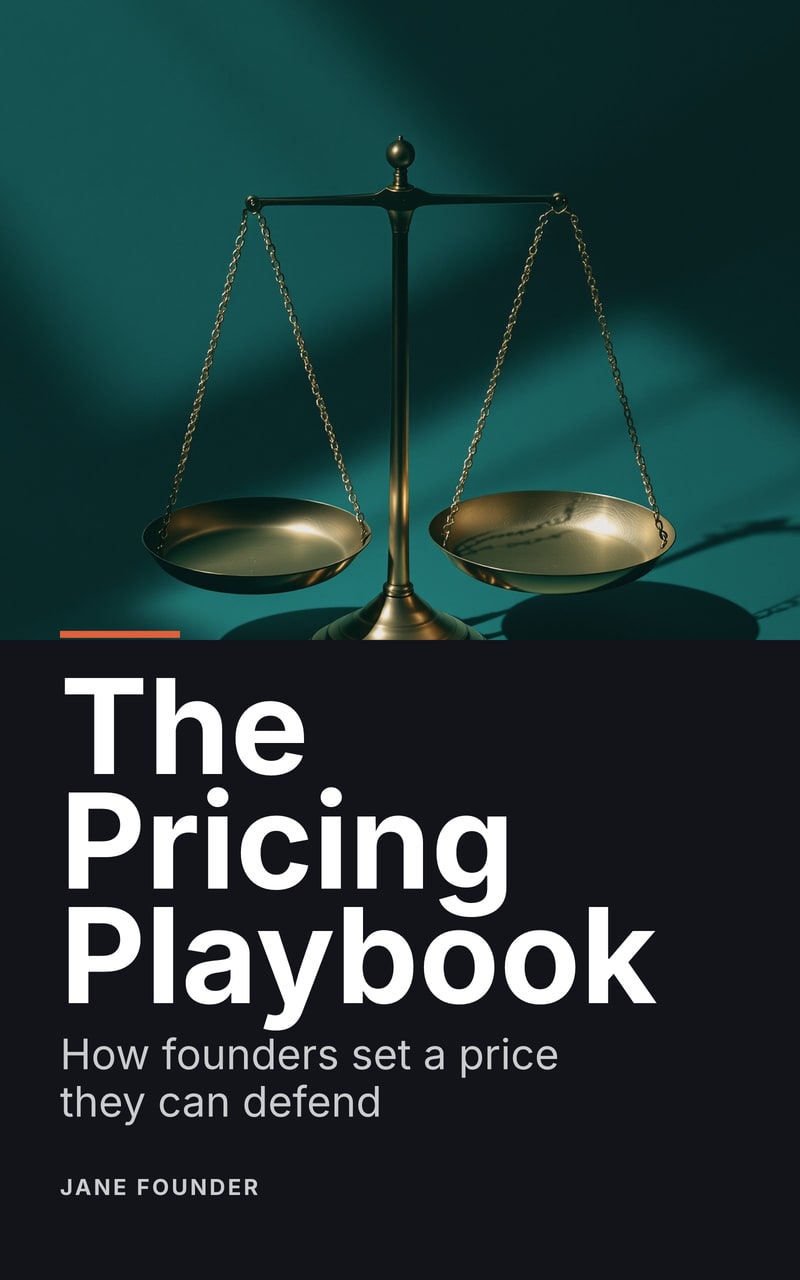


- 43 pages
- Digital PDF, 381 KB, 6 × 9 in. Fonts embedded, clickable contents, running heads.
- 9,862 words
- EPUB 3, 107 KB, with a navigable table of contents. Validated against EPUBCheck.
- Cover JPEG at 1600 × 2560, the size Amazon KDP asks for. Editorial look, artwork cover.
The credit figure above is what this first draft cost at the length it came out: planning, drafting every chapter, one complete review and one cover. Revisions and research add to it. See pricing for the per-action table and a calculator. Ready to write your own brief? Start free.
Write your own brief.
The outline and one sample chapter are free, so the fastest way to see whether Chapbook fits your book is to start one.