Five Pricing Mistakes
A ten-minute read for founders · Jane Founder
- Type
- Lead magnet (1,000-10,000 words)
- As generated
- 3,735 words · 17 pages
- Trim and style
- US Letter, 8.5 × 11 in. Editorial look, artwork cover.
- First draft
- Uses up to 70 credits
What this shows: one brief, run once through Chapbook at the lead magnet length and exported without a word of editing afterwards. It is not a customer's book.
The brief
- Topic
- The five pricing mistakes that cost early software companies customers, and what to do instead
- Promise
- In ten minutes you will recognise which of the five mistakes you are making and know the first step to fix each one
- Reader
- A technical or product-minded founder who set the price by copying a competitor or guessing, and suspects it is wrong
- Outcome
- Ship or reprice a paid plan with a number they can explain, and a plan to test it within a week
- Voice
- Short paragraphs, concrete examples with realistic fictional companies, no invented statistics or studies; reason from mechanics and examples
- Call to action
- Reply to the email that delivered this guide with the word SCRIPT to get the ten-question customer interview script
- Positioning
- For founders who guessed at pricing: a ten-minute read that names the mistake and the fix.
The guided brief in the app asks for exactly these fields.
What the planner proposed
Title options: Five Pricing Mistakes, The Price You Guessed, Priced by Accident, A Number You Can Explain, Why Your First Price Is Wrong. Positioning: For technical and product-minded founders who set their first price by copying a competitor or guessing, and suspect it is costing them customers. In ten minutes it names the five mistakes, shows which ones they are making, and hands them a first step for each so they can ship or reprice a plan with a number they can explain and a test running within a week.
- 01Introductionfront, 291 words
- 02Mistake 1: Copying a competitorbody, 558 words
- 03Mistake 2: One tier for everyonebody, 588 words
- 04Mistake 3: Never askingbody, 608 words
- 05Mistake 4: Anchoring on your costsbody, 641 words
- 06Mistake 5: Never revisiting the numberbody, 606 words
- 07What to do insteadback, 411 words
Read the chapter synopses the planner wrote
- IntroductionPromise: the reader sees themselves in the opening lines and knows exactly how to use the next ten minutes. Key points: (1) most first prices are shortcuts, copied, cost-based, or a safe-feeling guess; (2) the symptoms that the number is wrong: rare upgrades, customers paying without blinking, a price nobody can justify; (3) the goal is not a formula but a number you can explain plus a way to test it; (4) the guide uses fictional companies and mechanics, never invented statistics. Takeaway: read the five mistakes in order, mark the ones that describe you, then use the last section as a one-week plan.
- Mistake 1: Copying a competitorPromise: the reader recognises whether their price was borrowed and understands why a borrowed number is wrong even when the competitor is right. Key points: (1) a competitor's price is the visible tip of decisions you cannot see: decoy tiers, sales motion, customer type, staleness; (2) worked example, Ledgerline undercutting Tallyhaus and inheriting the 'cheap one' story; (3) undercutting builds a ceiling out of someone else's floor and anchors your own future decisions; (4) competitor prices are useful for learning what buyers expect, not for deciding. Takeaway: write the sentence 'We charge X because...' without naming another company; if you cannot finish it, this is your mistake.
- Mistake 2: One tier for everyonePromise: the reader sees why a single price is simultaneously too high for small customers and too low for large ones, and learns how to pick the axis that tiers should sort on. Key points: (1) worked example, Crewpad charging a four-person bakery and an eleven-site restaurant group the same $29; (2) a single tier throws away information and caps upside as customers grow; (3) tiers are a sorting mechanism, and the axis must track value to the customer, be visible to them, and not punish good use; (4) a three-tier table for Crewpad, named by who each plan is for. Takeaway: list your last ten customers, find the one axis that separates big from small, and draft three tiers on it with the middle one as the plan you want most people to pick.
- Mistake 3: Never askingPromise: the reader loses the fear of talking to customers about money and gets the exact questions to ask. Key points: (1) why founders avoid the conversation: fear of lowballing, embarrassment, treating price as arithmetic; (2) worked example, Kestrel Forms discovering in one call that its value is measured per business in office hours and avoided callbacks, not per technician; (3) never ask 'what would you pay'; ask about the alternative, its cost, and what would make double the price fair; (4) five conversations, including cancelled customers, are enough to see a pattern. Takeaway: email five customers today for fifteen minutes this week, ask the five questions, and record their exact words.
- Mistake 4: Anchoring on your costsPromise: the reader understands why cost-plus pricing fails in both directions and where costs actually belong. Key points: (1) worked example, Renderbox pricing a video API at cents per minute when the customer was comparing it with a freelance editor and a two-day wait, and the same formula pricing a notes app too high; (2) costs set the floor; the alternative the customer would otherwise use sets the ceiling; cost-plus forgets the ceiling exists; (3) a low price makes serious buyers nervous about your survival; (4) the double-it and halve-it check for whether you are anchored on cost. Takeaway: write your per-customer floor next to what the customer's alternative costs them; your price belongs nearer the second number, and the gap is your argument.
- Mistake 5: Never revisiting the numberPromise: the reader stops treating the launch price as settled and gets a trigger list so the review happens on purpose. Key points: (1) worked example, Clausebook shipping three years of features while staying at $12 and training itself to think like a $12 product; (2) the fear of raising prices is usually about the wrong customers; existing customers can be handled with notice, grandfathering, or an annual lock; (3) revisiting is not the same as raising; sometimes the honest answer is a lower entry tier; (4) a price change for new signups only is a reversible test, and silence about price is a warning, not a comfort. Takeaway: book a one-hour pricing review six months from today with the trigger list in the invite, and if the current price is over a year old and the product has changed materially, hold the review this week.
- What to do insteadPromise: the five first steps become one week of work that ends with a price the reader can explain and a test already running. Key points: (1) a day-by-day table: write the sentence and book calls, run the calls, set the floor and draft tiers, pick numbers and ship to new signups only, review at thirty days; (2) the finished 'We charge X because...' sentence as a model; (3) three signals that the new price is working. Takeaway and call to action: reply to the email that delivered this guide with the word SCRIPT to get the ten-question customer interview script.
Research plan, 8 items to verify: Check that the fictional company names (Ledgerline, Tallyhaus, Crewpad, Kestrel Forms, Renderbox, Clausebook) do not collide with real products in the same category; rename any that do; Confirm the decoy-tier mechanic (a low anchor plan that makes the mid plan look reasonable) is described from mechanics only, with no implied study or statistic; Verify the Crewpad three-tier table is internally consistent: staff and location caps, prices, and the revenue arithmetic for the two example customers; and more.
The book, as exported
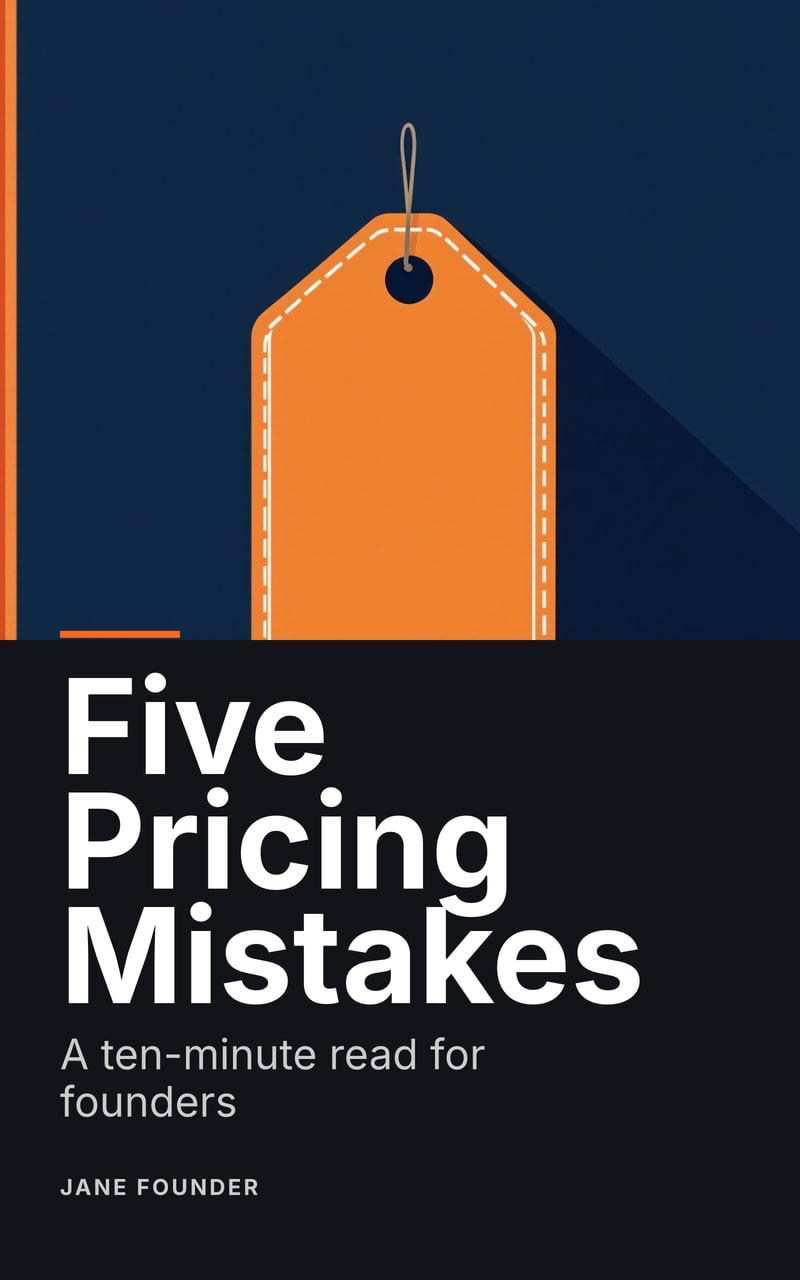


- 17 pages
- Digital PDF, 163 KB, US Letter, 8.5 × 11 in. Fonts embedded, clickable contents, running heads.
- 3,735 words
- EPUB 3, 69 KB, with a navigable table of contents. Validated against EPUBCheck.
- Cover JPEG at 1600 × 2560, the size Amazon KDP asks for. Editorial look, artwork cover.
The credit figure above is what this first draft cost at the length it came out: planning, drafting every chapter, one complete review and one cover. Revisions and research add to it. See pricing for the per-action table and a calculator. Ready to write your own brief? Start free.
Write your own brief.
The outline and one sample chapter are free, so the fastest way to see whether Chapbook fits your book is to start one.